






Suitable from age 2
NuBest Tall Gummies
For children who don't drink milk daily
$55.00
60
ct
· one-time
Start with age, then match the formula to their need. Check each product’s minimum age.
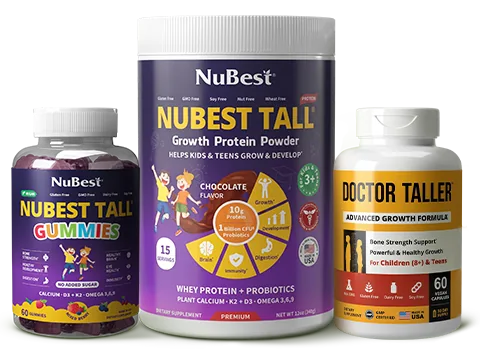
Shop all supplementsNuBest Tall, by age and format.
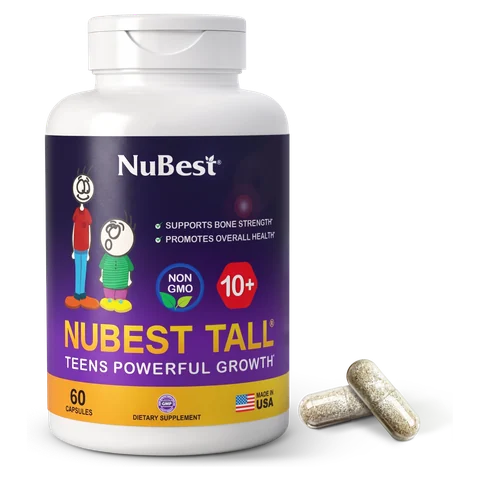
NuBest’s multivitamin for teenagers allows you to optimize your child’s growth potential. More often than not, teenagers require extra nutrients to level up their bone strength, muscle mass production, immunity, and metabolism. Composed of natural ingredients, vitamins D3 and K2, and vital minerals, our supplements for teens are the fuel you have been seeking.
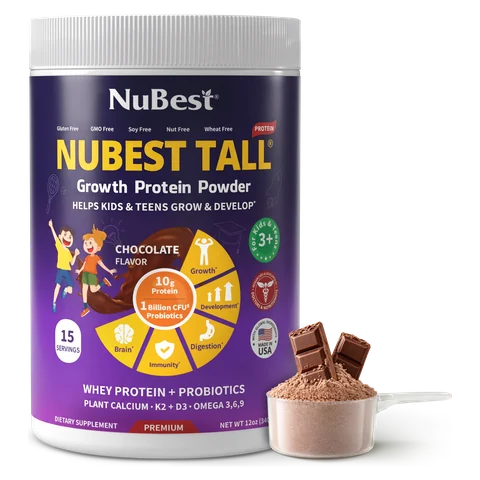
If the question “How to get taller as a teenager?” or “What is the minimum age for multivitamins?” has been on your mind for quite some time, NuBest Nutrition has the true answers. Our formula covers a wide age range with multiple options to choose from: capsules, chewable tablets, effervescent, and powder. Always putting customers first, we aim to cater to your overall wellness with high-quality supplements. Our products are 100% gluten-free, non-GMO, based in the U.S., and manufactured in an FDA-registered facility.
Besides being safe, cost-effective, and convenient, NuBest’s vitamins for teenage growth guarantee exceptional results when incorporated into a healthy diet and active lifestyle. It’s time to step up, take measured actions, and let NuBest’s supplements open new doors for your growing teens!
Remove one condition to widen the results.
You’ve viewed 8 of 11 products
Plenty of parents go looking for one winner here. One bottle, one label, problem solved. It rarely works that way. At 14, a girl's body is running several projects at once (bones lengthening, periods starting, the brain rewiring itself), and each one leans on different nutrients. Vitamins A, B-complex, C, D, E, and K all have a job.
So the "best" vitamin is usually a plate, not a pill. Nutritionists tend to point toward meals built from all five food groups. The habits around the food count too: how much she moves, how many hours she actually sleeps, whether she drinks water or mostly soda. Those are among the factors determining excellent growth, and they get overlooked when everyone's staring at the supplement aisle.
Ask five people and you'll get five answers. In practice, supplements can be safe at 15, provided a doctor has looked things over first. That checkup sounds like a formality. It isn't. A simple blood test sometimes shows the teen didn't need the supplement at all, or needed something else entirely (low iron is a common surprise for girls).
The trap is treating capsules as a stand-in for breakfast. Skip real meals for a few weeks and the gaps start showing: afternoon crashes, foggy focus in class, that constant "why am I so tired" feeling.
For most teens, the useful mix covers vitamin A, B-complex, C, D, and K. Written out like that, it looks like a pharmacy list. Real life is friendlier. A salad with three or four colors, a banana and spinach smoothie before school, a glass of fresh orange juice, and a decent chunk of the list is already handled.
When your meals look different from day to day, vitamin intake tends to even out on its own. Nobody needs a spreadsheet for this.
Here the numbers get specific. Girls need roughly 700 mcg a day, boys about 900 mcg. Those figures shift a little with body size, diet, and health history, and honestly, the research on where each individual teen lands is thinner than you'd expect.
Overdoing it happens more easily than people assume. Vitamin A gets stored in the liver, so the extra doesn't just wash out. Stack a multivitamin on top of fortified cereal and a skin supplement, and the total creeps up quietly. Checking reliable guidance, or simply asking a healthcare provider, takes about five minutes.
Yes. Lots of teens do, especially around exam season, when sleep shrinks and snacks replace dinner. Vitamin C supports general health, and a supplement can fill in during those weeks.
But it's not magic. Taken alongside late nights and vending machine lunches, the effect feels... pretty minimal. Paired with steady sleep, decent meals, and some kind of routine, it finally has something to work with.


